hero: true heroOrder: 1
The compact cinema camera market has never been more competitive, and Canon is making a serious push to reclaim its place at the top. The Canon C50 is the company's latest Cinema Line entry — a compact body capable of recording up to 7K open gate internally, designed to appeal to content creators, indie filmmakers, and professional set work alike. After taking the C50 out on several real shoots, here's an honest look at what it does well, where it falls short, and who it's actually built for.
A Camera With Big Shoes to Fill
Canon's legacy in video is hard to overstate. The 5D Mark II was a genuine turning point — it brought HD video to a DSLR body and found its way onto Hollywood sets as a crash cam, security camera, and B-roll workhorse. That camera changed how filmmakers thought about what a "cinema camera" could look like.
The question with the C50 is whether Canon can recapture that same energy in today's market. Its most obvious competitor is the Sony FX3, a camera that has become a fixture on professional sets — used as a crash cam, a FaceTime recording rig, and in countless other creative configurations. The C50 is clearly gunning for the same space.
7K Open Gate: What It Means and Why It Matters
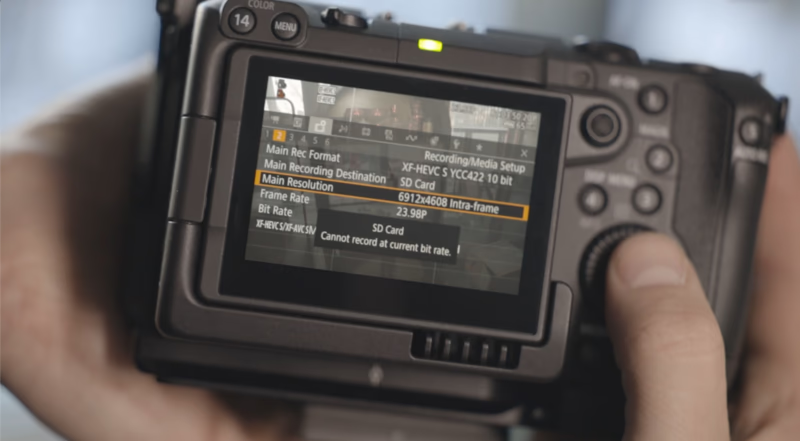
The headline spec on the C50 is 7K open gate internal recording, and it's worth explaining why that's significant. Open gate recording uses the full sensor area without any crop, giving you maximum resolution and the most flexibility in post. Until recently, this was a feature reserved for high-end cinema cameras found on film and television sets — seeing it in a compact, accessible body is genuinely notable.
The practical benefit for modern content creators is significant. Shooting open gate at 7K gives you a 16:9 horizontal frame with enough extra height to crop a clean vertical frame from the same clip — meaning you can deliver both landscape and portrait formats from a single take. In an era where short-form vertical content and long-form horizontal video often need to coexist, that's a genuinely useful workflow advantage.
The C50 takes this a step further with its dual card slot system — one SD and one CFexpress Type B. You can record the full 7K horizontal frame to one card while simultaneously recording a vertical crop to the other. Even if you choose not to use simultaneous recording, vertical frame guides let you compose for both formats within a single horizontal frame. On a recent shoot where both formats were needed for the final edit, this workflow proved seamless and efficient.
Build Quality, Ergonomics, and the Overheating Question
The C50 is surprisingly light for a cinema-class camera body. It's compact enough to move quickly, but the weight distribution feels considered — substantial enough to reduce handheld shake and jitter, but not so heavy that it becomes a burden over a long shoot day. At 6'5", the reviewer found the grip comfortable even with larger lenses mounted, which says something about how well the ergonomics scale.
The body is slightly larger than you might expect for its class, and that's intentional. Canon has built in multiple cooling fans to address the overheating issues that plagued some of its earlier video-capable releases. After several hours of continuous 7K open gate recording at 10-bit 4:2:2, the camera did not overheat once. For anyone who has dealt with Canon's previous thermal limitations, that's a meaningful improvement.
The included top handle elevates the C50 beyond a simple grip accessory. It adds two XLR inputs and audio channel mixing directly to the camera — transforming it into a scaled-down version of Canon's larger Cinema Line bodies. Pair it with a cage, a matte box, a follow focus, and a V-mount or gold-mount battery plate, and you have a capable cinema rig that punches well above its size.
Battery Life: Plan Accordingly
This is the C50's most significant practical limitation. The combination of active cooling fans, high-bitrate recording, and a continuously powered screen draws heavily on the battery. On a standard Canon LP-E6 battery, expect roughly 45 minutes of use per charge under typical shooting conditions.
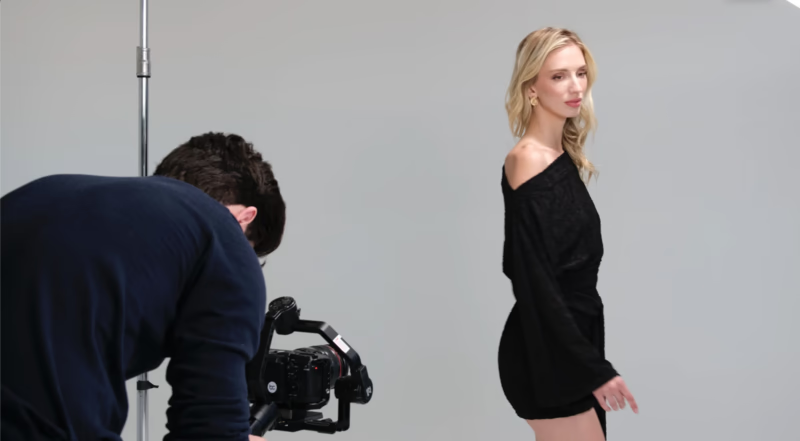
For run-and-gun work, this means carrying a generous supply of LP-E6 batteries and budgeting time for swaps. For larger productions or extended shoots, powering the C50 via a V-mount or gold-mount battery system is strongly recommended. It's not a dealbreaker, but it's something to plan around from day one.
The IBIS Debate: Missing Feature or Deliberate Choice?
The absence of in-body image stabilization has been a talking point since the C50 was announced. The counterargument is worth hearing out. IBIS is genuinely valuable in hybrid photo-video cameras used for content creation, handheld documentary work, or situations where a gimbal isn't practical. The C50 can also capture 30-plus megapixel RAW stills, making it a capable hybrid tool even without an electronic viewfinder.

But consider the professional set context. When a camera is deployed as a crash cam or B-camera on a larger production, IBIS can become a liability. If a crew member unfamiliar with the camera forgets to disable stabilization before a deliberately shaky handheld shot, or before mounting it on a gimbal, the result can be unusable footage. On a working set, that kind of error has real consequences. The C50's dedicated timecode input reinforces the idea that Canon is targeting exactly this market — the camera is designed to slot into professional multi-camera workflows, and omitting IBIS appears to be a deliberate choice rather than an oversight.
For solo creators and indie filmmakers, the lack of IBIS is more noticeable. A gimbal or stabilized lens goes a long way toward compensating, but it's a consideration worth factoring into your decision.
Practical Tips for Getting the Most From the Canon C50
- Invest in a V-mount or gold-mount battery solution from the start if you plan to use the C50 for longer shoots. LP-E6 batteries will drain fast.
- Use the dual card slot workflow to record horizontal and vertical formats simultaneously when producing for multiple platforms.
- Build out the rig thoughtfully. A cage, matte box, and follow focus transform the C50 into a full cinema setup without adding excessive bulk.
- Lean into Canon Raw. The full Raw recording option gives you maximum flexibility in color grading and post-production.
- Use vertical frame guides even when recording a single format — it makes repurposing footage for social media far easier in the edit.
- Disable any lens stabilization when mounting on a gimbal to avoid competing stabilization systems.
Conclusion
The Canon C50 is a genuinely exciting camera that signals Canon's serious return to the cinema and professional video market. It delivers 7K open gate recording, solid thermal management, excellent ergonomics, and a dual-format workflow that makes it highly practical for modern content pipelines. The dedicated timecode input and XLR-equipped top handle make it a credible option for professional set work alongside the Sony FX3.
The short battery life is a real limitation that requires planning, and the lack of IBIS will matter more to some shooters than others. But for filmmakers, indie directors, and content creators who lean toward the cinematic side of the spectrum, the C50 is a compelling and versatile tool. A direct comparison against the Canon R6 Mark III would help clarify exactly where each camera fits in the lineup — but as a standalone cinema-focused body, the C50 is well worth serious consideration.
Frequently Asked Questions
Q: How does the Canon C50 compare to the Sony FX3? Both cameras target similar professional use cases — compact cinema bodies suitable for set work, crash cam applications, and run-and-gun filmmaking. The C50 offers higher resolution with 7K open gate recording and a dedicated timecode input, while the FX3 has IBIS and an established track record on professional sets. The right choice depends on your specific workflow and whether resolution or stabilization is the higher priority.
Q: Does the Canon C50 overheat during extended recording? In hands-on testing with several hours of continuous 7K open gate 10-bit 4:2:2 recording, the C50 did not overheat. Canon's inclusion of multiple internal cooling fans appears to have addressed the thermal issues that affected some of its earlier camera releases.
Q: Why doesn't the Canon C50 have IBIS? Canon appears to have made a deliberate decision to omit IBIS, likely because the C50 is designed in part for professional set use — where unintended stabilization can interfere with intentional camera movement or compete with gimbal systems. For solo content creators, a gimbal or stabilized lens is the recommended workaround.
Q: How long does the Canon C50 battery last? On a standard Canon LP-E6 battery, expect approximately 45 minutes of use under typical shooting conditions. For extended shoots, powering the camera via a V-mount or gold-mount battery system is strongly recommended.
Q: Can the Canon C50 shoot vertical video natively? Yes. The C50 supports simultaneous recording of horizontal and vertical formats using its dual card slots — one SD and one CFexpress Type B. It also offers vertical frame guides for composing both formats within a single horizontal frame, making it well-suited for creators who produce content across multiple platforms.