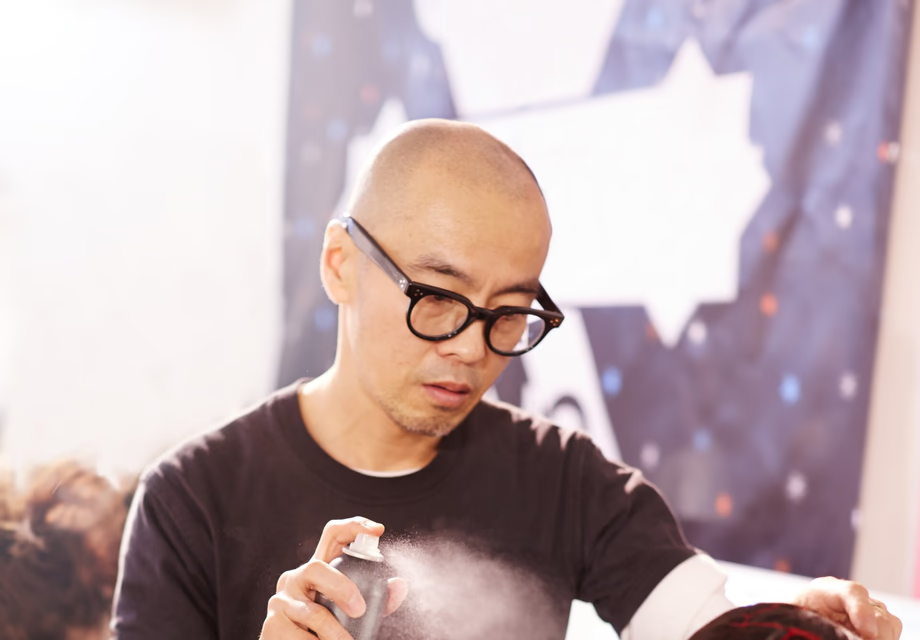
Vogue's backstage photographers have covered hundreds of shows between them, and when they sat down to describe the moments that stayed with them across roughly twenty years of fashion months, the memories were not about spectacle.
They remembered a model stealing a nap between fittings. A designer's trembling hands before a walk. A hug that nobody had planned. The images that lasted were the quiet ones, which is a useful corrective to the assumption that backstage coverage is about documenting drama.
Three Photographers, Three Perspectives
What makes the magazine's backstage coverage distinctive is that it is produced by three photographers working the same events with different instincts. No single person could produce that record, because the coverage is not a set of better or worse pictures of the same things. It is three different selections from the same chaos.
The arrangement is worth understanding even for a photographer who works alone, because it describes what good coverage actually is.
Different distances. One photographer works close, filling the frame with a face or a detail; another stands back and photographs the production around a person. Both are necessary, and neither substitutes for the other.
Different moments. Some photographers look for the peak of an action and others for the second before it or after it. Across a set, the second and the after are usually what make the first legible.
Different relationships. Photographers have different levels of access to different people backstage. A dresser who ignores one photographer will talk to another, and the images reflect those individual relationships.
Different tolerances. One photographer will stay in a difficult corner for three hours, and another will work the route. The coverage is a product of both decisions.
For anyone documenting an event alone, the transferable instruction is to vary deliberately: change distance, change timing within an action, and change position between sessions rather than finding one workflow and repeating it.
The Stories That Endure
The most useful observation in the whole conversation is that the images which lasted are not the images of the biggest moments.
That is counterintuitive, because the biggest moments are what photographers are sent to cover. A photograph of the finale, with the lights and the applause, is likely to look like the finale photograph taken at every other show. The images that stay in the archive are the ones that carry the human evidence of what the day cost and gave to the people involved.
The specific subjects the photographers remembered, a nap, a tremor, an embrace, share a structure. Each is a moment when someone stopped performing. That is the actual subject of backstage photography, and it is the quality worth looking for deliberately rather than hoping to catch.
Which leads to a practical reframing for anyone working in a high-pressure environment. The event itself will be covered by everybody. The preparation, the aftermath, the boredom, the small exchanges between people who have worked together for years: those are covered by almost nobody, and they are what the archive will want in a decade.
Trust Earned Over Years
The access behind this kind of coverage is not a credential. It is a relationship, and the photographers' accounts are consistent on how it develops.
It is granted incrementally. A first season backstage is a trial. Reliability is what converts permission into welcome.
It is protected by discretion. The unpublished frame of a person in an unguarded moment is what buys continued access. Publishing it costs the relationship permanently.
It is maintained by usefulness. Delivering files on time, correctly labelled, with the right credits, matters as much as the photographs themselves.
It survives on everyone being treated equally. The dressers, the assistants, the security staff and the models all contribute to whether the photographer is welcome. Photographers who only acknowledge the people whose names are on the call sheet do not last.
It is impossible to rush. There is no shortcut to being trusted in a room, and the photographers who try to skip the years do not get them back.
Practical Tips
- Multiple photographers produce richer documentation than a single perspective. Vary distance, timing and position deliberately.
- The moments that endure are usually the quiet, human ones. Look for the second when someone stops performing.
- Trust between photographer and subject is earned over years, not granted at the door.
- Sometimes the best image is the one that almost did not happen. Keep the near-misses.
- Photograph the preparation and the aftermath, not only the event.
- Learn the running order so you can be positioned before each moment rather than during it.
- Treat everyone in the room with the same attention. Access is collective property.
- Protect access with discretion. One careless frame ends a relationship permanently.
Further Reading
- all the stars on the London front row
- smiles take centre stage at NYFW
- fashion week events and who attends
Conclusion
Twenty years of backstage coverage, viewed through three photographers' memories, produces a clear conclusion: the spectacle photographs itself, and the human moments are the ones that require someone to be paying attention.
The lesson is available without press credentials or a fashion month schedule. Whatever event you cover, photograph the hours around it, watch for the moment when performance stops, keep the frames that almost did not work, and treat the access as something you are borrowing from the people who let you in. That is the difference between coverage and a record.
FAQ
How do Vogue's backstage photographers work together?
Three photographers with different ways of seeing cover the same events, producing a multidimensional portrait of a fashion month. The variation in distance, timing and position generates richer documentation than any single photographer could manage.
How can I get started in backstage photography?
Begin with smaller, local events where access is easier to obtain, build relationships over time, and learn to be present without being intrusive. A portfolio showing that you can capture intimate moments respectfully is what opens the larger doors.
Why do quiet moments last longer than dramatic ones?
Because the dramatic moment is photographed by everybody, so the resulting images look alike. The quiet moment is unique to the day, and it carries the human evidence that gives an archive its value.
What camera and settings work backstage?
A fast wide or standard lens, a shutter speed of 1/250 or faster, and Auto ISO for the changing light. Available illumination or a small flash keeps the atmosphere intact, which matters more than technical perfection in that environment.
How long does it take to be trusted backstage?
Several seasons of reliable, discreet work. The trust is granted incrementally and lost immediately, which is why professional photographers treat discretion as a technical skill rather than a personality trait.
What should a backstage photographer not do?
Do not direct people unnecessarily, do not stand between a dresser and a model, do not publish an unflattering frame of someone who trusted you, and do not treat the crew as staff. None of those mistakes is recoverable in the same room.